
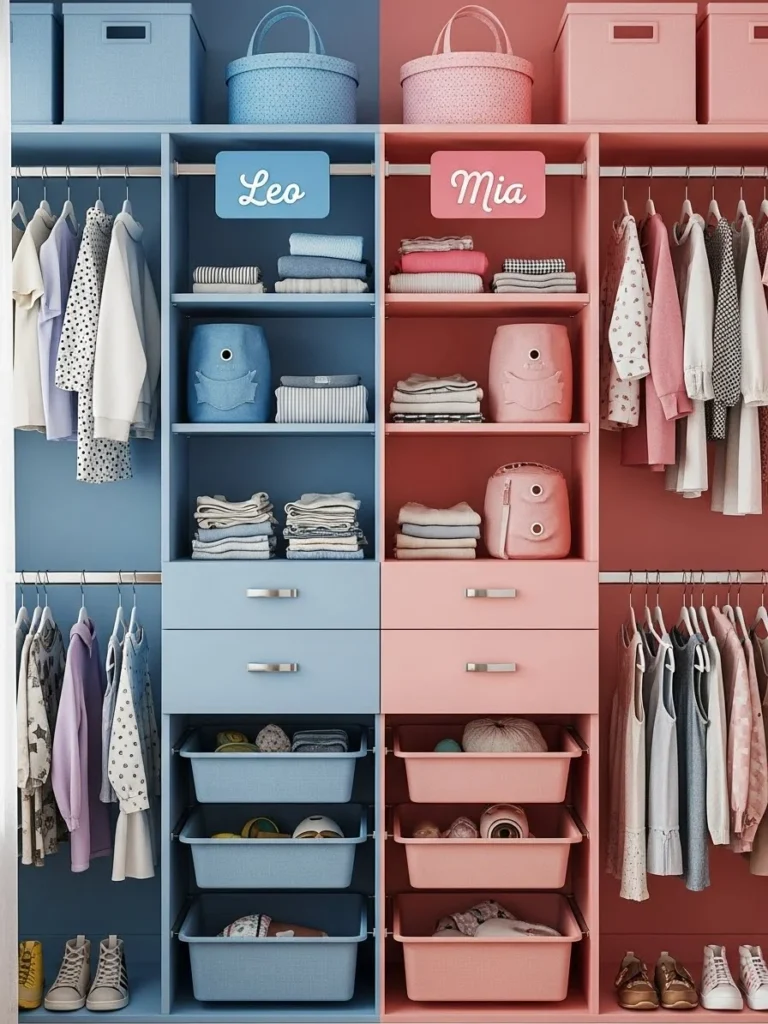

Sharing a bedroom often means sharing a closet, which can quickly turn into daily battles over space, missing clothes, and confusion over whose items belong where. But with kids clothes storage ideas for shared bedrooms, this common problem can be solved with clever organization and smart planning. The secret lies in creating fair divisions and clear boundaries so each child has their own designated zone.
When shelves, bins, and hanging organizers are thoughtfully assigned, every item has a place, and the chaos disappears. From using vertical storage to labeled baskets and rotating seasonal clothing, these storage solutions help maximize space, keep clothes accessible, and ensure that even the smallest shared bedroom remains functional, tidy, and stress-free for both kids and parents.
Ready to create closet harmony for siblings sharing space? These ideas work for kids of all ages! For more ways to organize your entire shared room, explore our complete kids organization ideas collection.
1. Divide Closet in Half with Clear Visual Boundaries
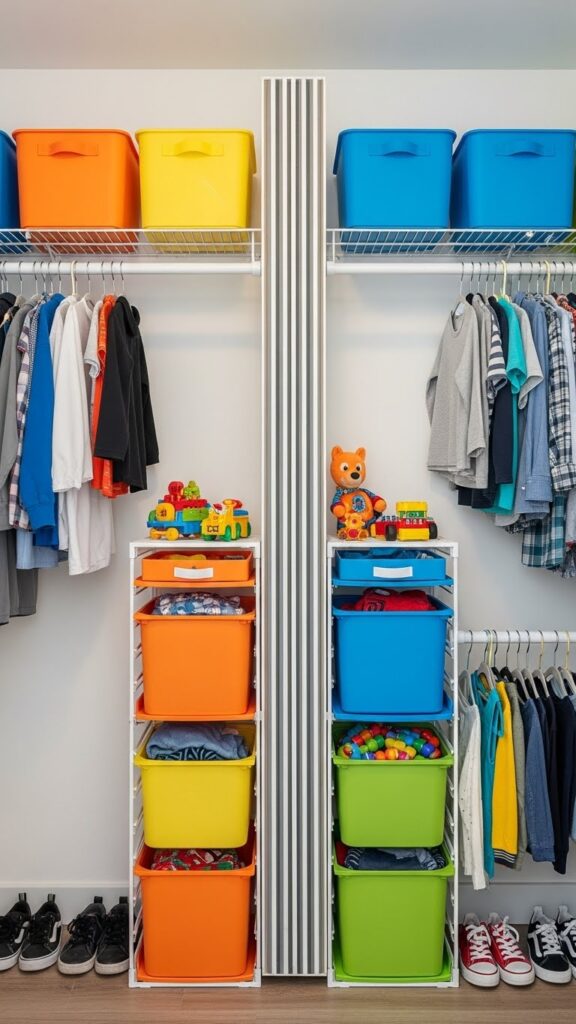
Dividing the closet down the middle creates fair territory that prevents “you’re on my side” arguments. Use the rod’s center point as your dividing line and give each child exactly half the space. Mark the boundary with a hanging closet divider, different colored hangers, or even a piece of ribbon tied to the rod. This visual marker makes it crystal clear where one child’s space ends and the other’s begins. Equal space means equal respect and fewer sibling conflicts over closet territory. For comprehensive organization strategies across all closet types, check out our main kids closet organization ideas guide with 27 solutions. Your peace treaty starts here!
2. Use Color-Coding to Identify Each Child’s Items
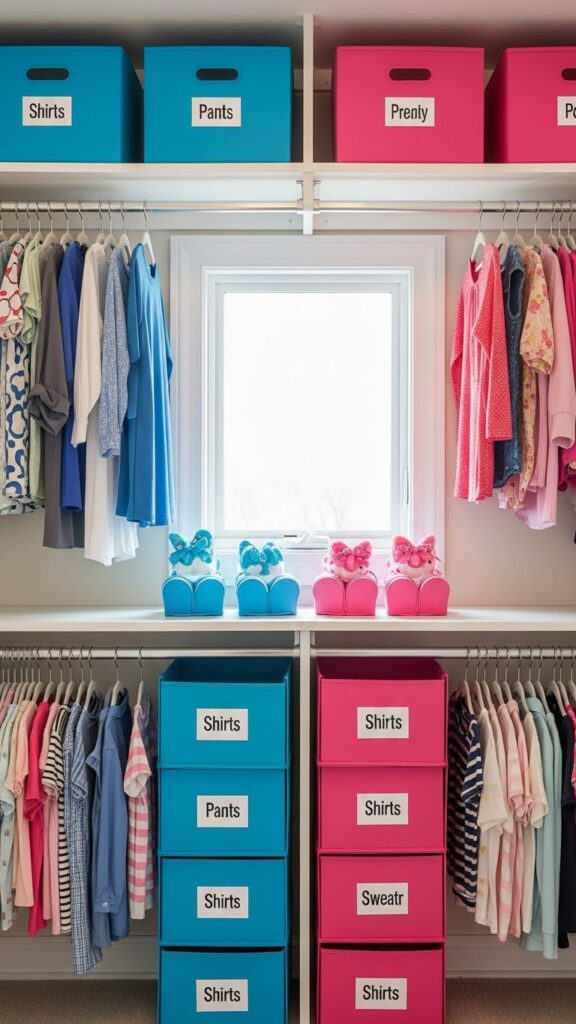
Color-coding eliminates the “that’s mine!” arguments because everyone can see at a glance who owns what. Assign each child a color—blue hangers for one, pink for another, or any combination that works. Use matching colored bins, labels, and even drawer dividers in their assigned color. This system works brilliantly for laundry day since you can sort clothes by color instantly. Even young kids who can’t read yet understand color coding. The consistency makes putting laundry away easier and keeps boundaries clear. It’s visual organization that actually works!
3. Install Double Hanging Rods with Designated Sides
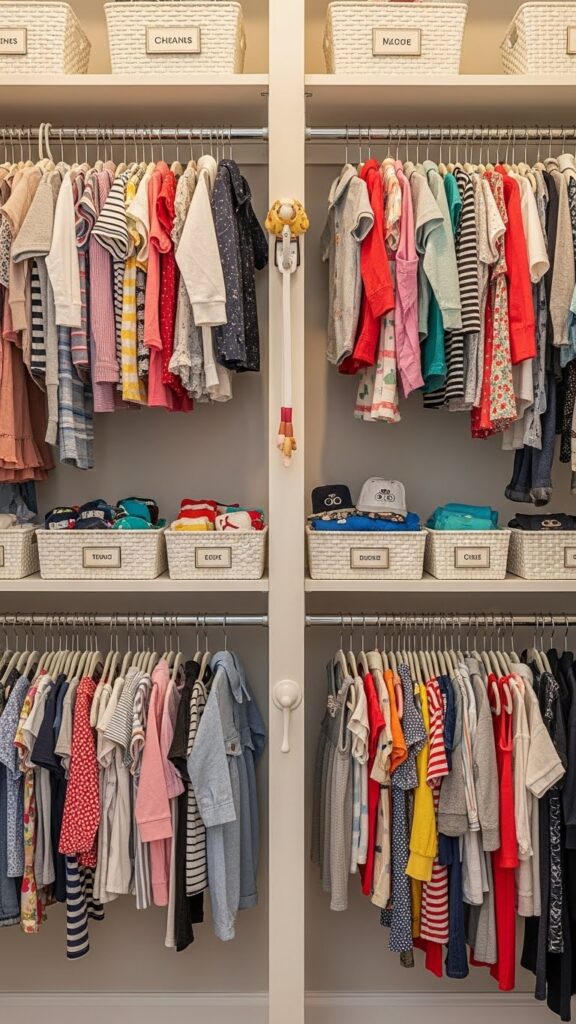
Double rods with designated sides give each child their own two-tier hanging system. Install two rods vertically—top and bottom—then divide them horizontally by child instead of mixing clothes together. One child gets both rods on the left side, the other gets both rods on the right. This prevents mixing and makes it clear that each child has equal vertical space. Use the top rod for dresses and longer items, bottom rod for shirts and shorts within each child’s zone. For more space-maximizing strategies, explore our vertical storage ideas for kids closets. Your rods divide fairly!
4. Label Everything with Names or Initials
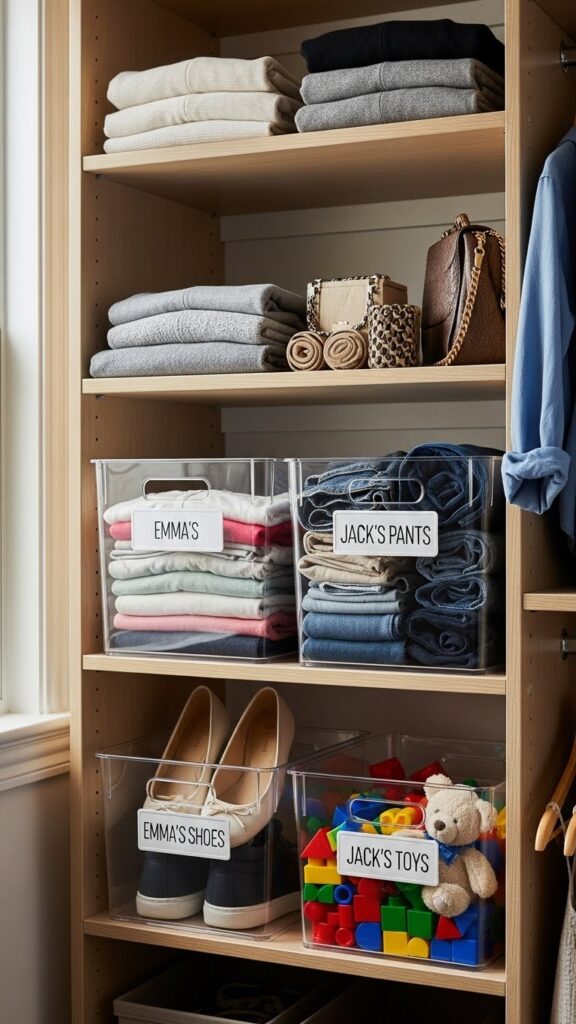
Labels with names eliminate confusion about ownership in shared spaces. Put each child’s name on their shelves, bins, drawers, and even sections of hanging space. “Emma’s Shirts” and “Jack’s Pants” make it obvious where items belong during laundry time. This reduces arguments and teaches kids to respect each other’s spaces. For younger kids who can’t read yet, add their photo next to their name on labels. The personalization helps kids take ownership of keeping their designated areas organized. Laminated labels withstand years of use in busy shared closets. Your labels settle disputes!
5. Use Separate Dressers or Drawer Units for Each Child
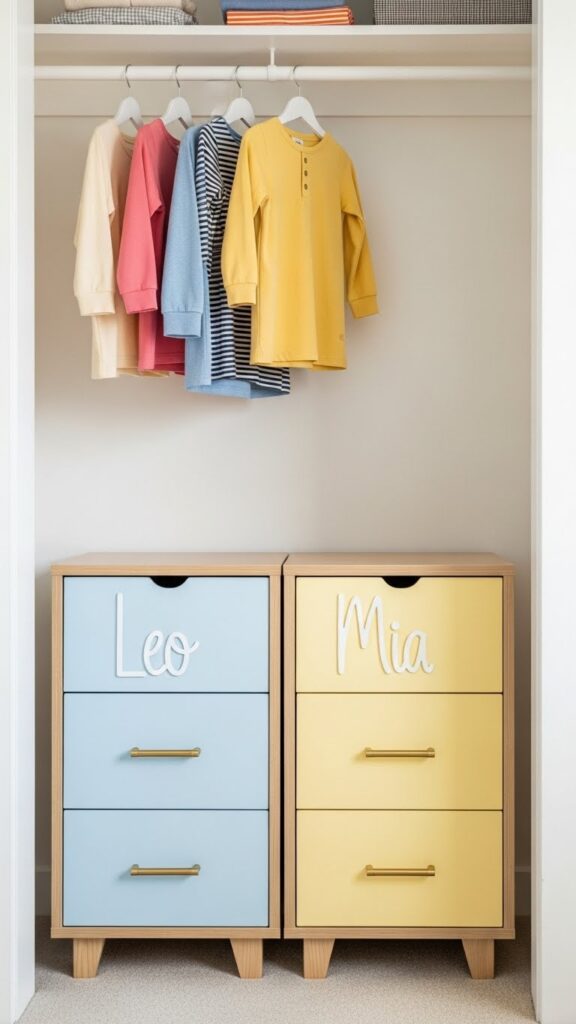
Separate drawer units give each child completely independent storage that’s unmistakably theirs. Place two small dressers inside the closet if space allows, or position them near the closet in the bedroom. Each child gets their own set of drawers to manage independently. This eliminates mixing of folded clothes and teaches individual responsibility. Choose matching units in different colors, or let each child pick their favorite style. When everything has its own furniture piece, there’s no confusion about whose drawer is whose. For apartment dwellers with limited space, check out our space-saving kids closet storage ideas. Your drawers stay separate!
6. Create Individual Bins for Each Clothing Category
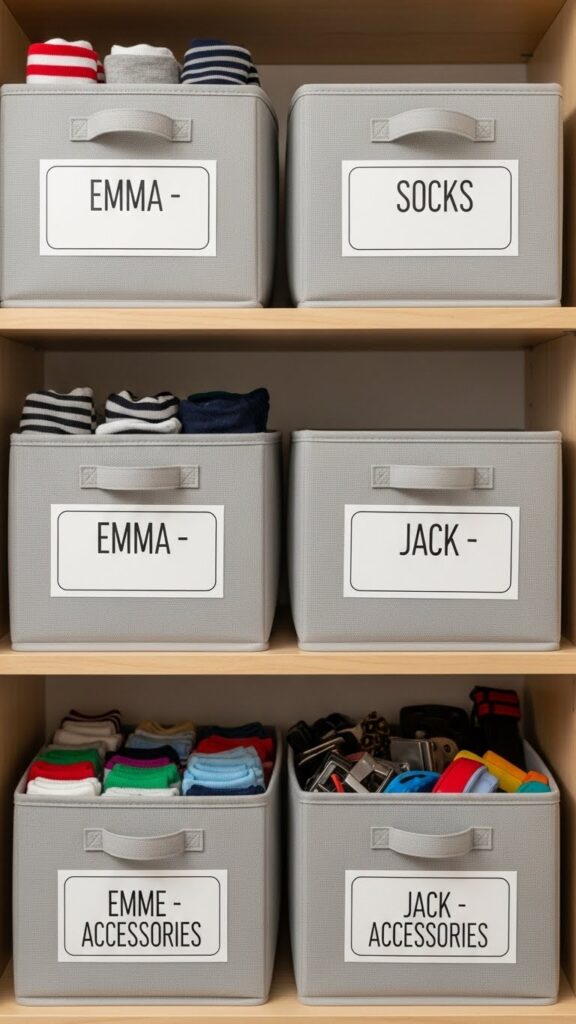
Individual bins for each child by category keep items completely separate even when sharing shelves. Instead of one bin for “socks,” use two bins—”Emma’s Socks” and “Jack’s Socks.” This prevents mixing and makes laundry sorting straightforward. Each child gets their own set of bins for socks, underwear, accessories, and small items. Stack bins vertically with each child’s set on their designated side of the shelf. Use clear bins so contents are visible, or color-coded opaque bins for quick identification. Your bins double up!
7. Install Hooks at Different Heights for Each Child
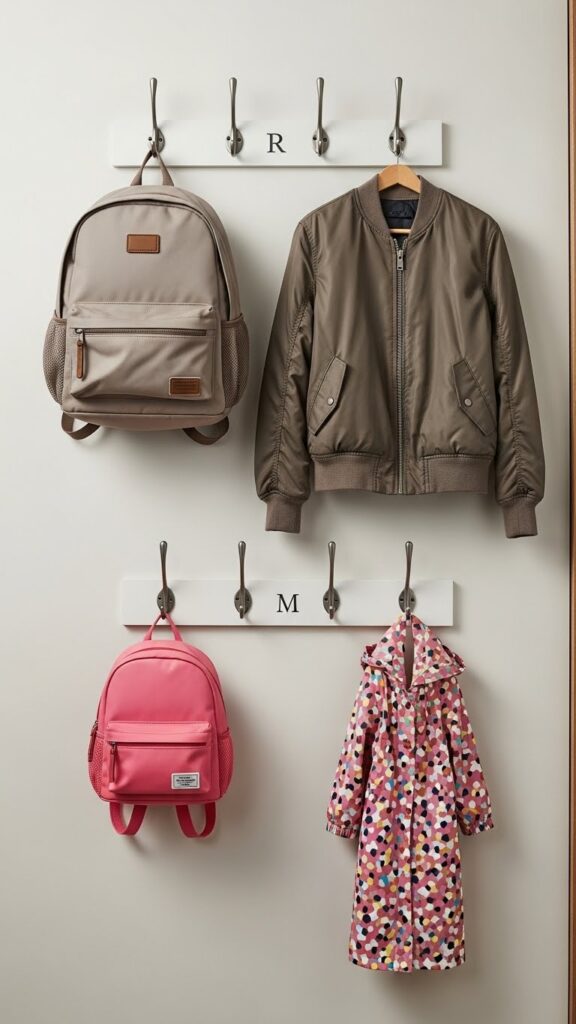
Different height hooks accommodate siblings of different ages while giving each their own space. Install lower hooks for the younger child at their shoulder height, and higher hooks for the older child. This natural separation prevents conflicts because each child can only comfortably reach their own hooks. Use three hooks per child—one for backpack, one for jacket, one for tomorrow’s outfit. Color-code hooks by child if they’re at similar heights. For complete morning routine systems, our kids wardrobe organization ideas for daily routines streamline getting dressed. Your heights divide naturally!
8. Use Closet Dividers to Mark Sections on the Rod
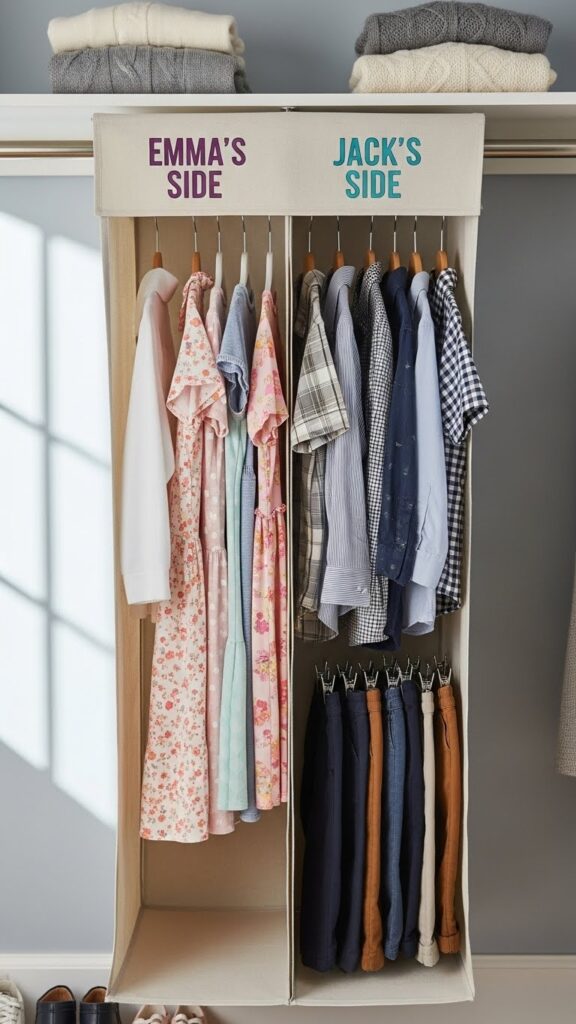
Hanging dividers create physical boundaries on the closet rod that make sections obvious. These simple tags slide onto the rod and mark territory clearly—everything to the left of the divider is Emma’s, everything to the right is Jack’s. Use decorative dividers with names, or DIY versions with labeled clothespins. The physical marker prevents clothes from drifting into the other child’s space. When hanging laundry, the divider makes it clear where items belong. This simple tool dramatically reduces “you put that on my side” complaints. Your rod has borders!
9. Assign Each Child a Side (Left vs Right)
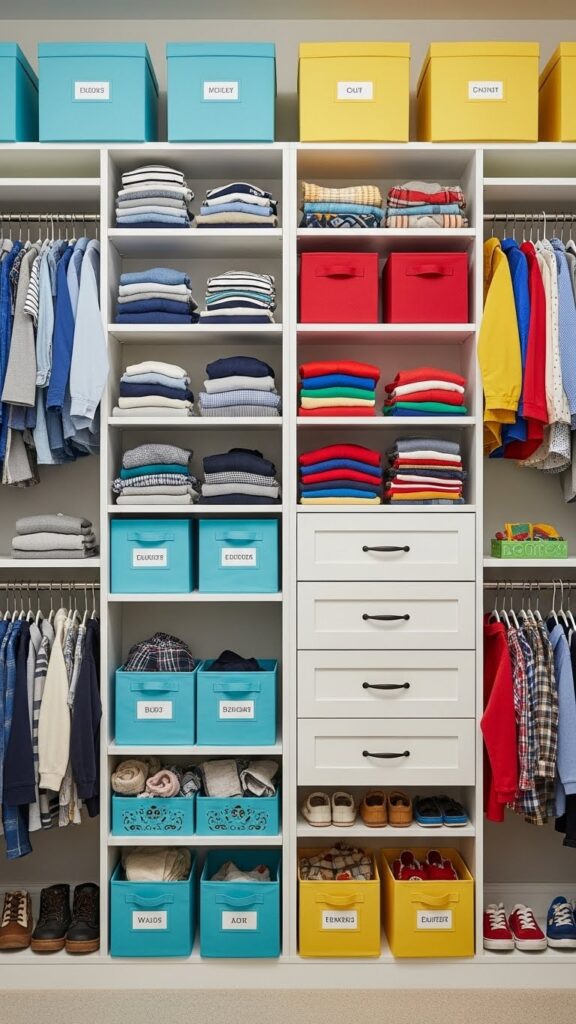
Left versus right division is the simplest, clearest way to split shared closet space. One child gets everything on the left—hanging space, shelves, floor space—while the other gets everything on the right. This straight-down-the-middle approach feels fair because it’s mathematically equal. Even very young kids understand “your side” versus “my side” with this layout. Use vertical organization within each side to maximize each child’s territory. The simplicity means less confusion and fewer arguments about space. Your middle line matters!
10. Create Personalized Hanging Sections with Photos
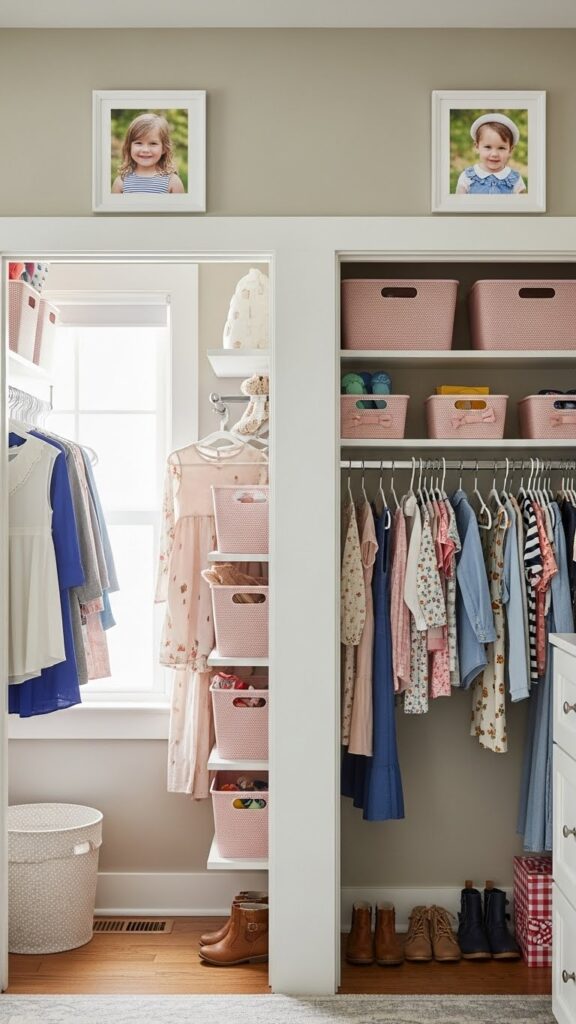
Photos of each child above their section add personal touches that make ownership crystal clear. Hang a small framed photo or stick a printed photo above each child’s designated area. This visual marker is especially helpful for young kids who can’t read labels yet. The personalization makes kids feel proud of their space and more likely to keep it organized. Update photos yearly as kids grow to keep the system current. This simple addition transforms anonymous closet space into “my special area.” Your photos mark territory!
11. Use Matching Storage Systems in Different Colors
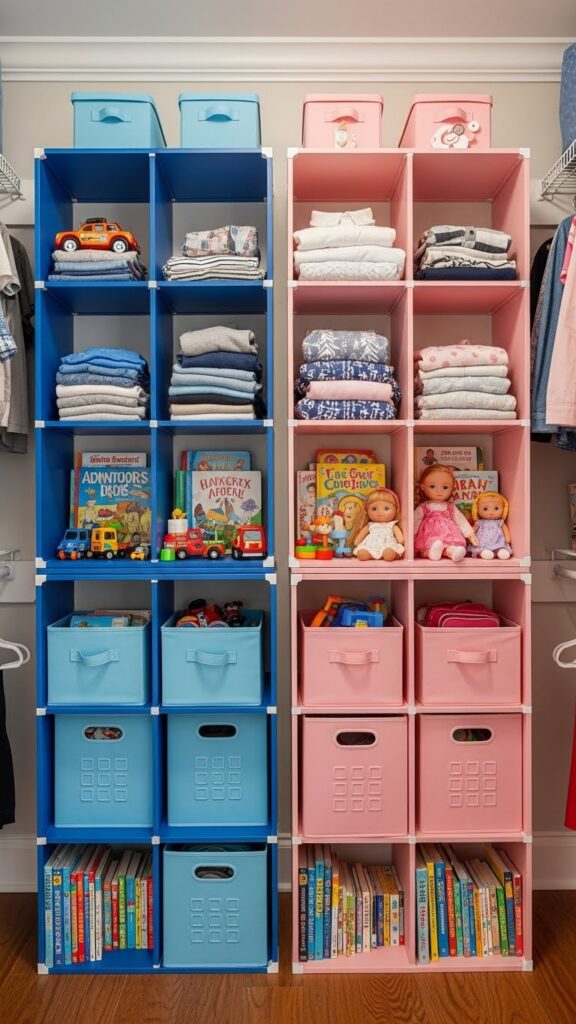
Matching storage in different colors gives each child equal organization while maintaining visual separation. Buy two identical sets of storage cubes, bins, or organizers in different colors—one child gets blue, the other gets pink (or any color combo). The matching means neither child has “better” storage, which prevents jealousy. The different colors make ownership obvious at a glance. This approach works for any age and grows with kids since you can buy new matching pieces as needed. Equal but distinct is the goal!
12. Install a Shelf Divider to Separate Folded Clothes
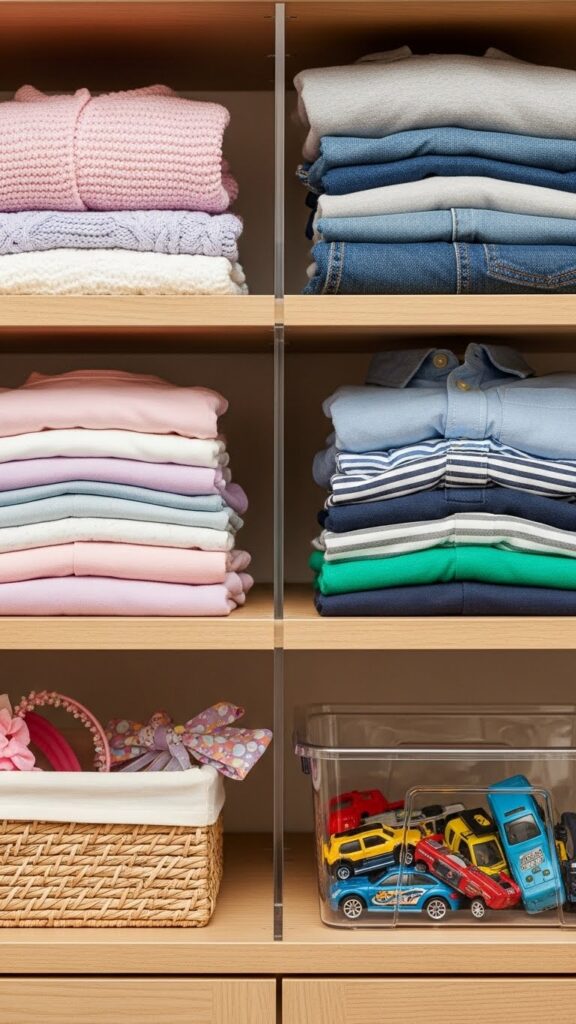
Vertical shelf dividers create physical barriers between each child’s folded clothes on shared shelves. These acrylic or wire dividers stand upright on shelves and prevent clothes stacks from mixing together. Place a divider in the center of each shelf to mark the boundary—left side for one child, right side for the other. The barrier keeps stacks from toppling into each other and makes it obvious where each child’s territory begins. This works especially well for kids who share one closet shelving unit. Your shelves split fairly!
13. Use Rolling Carts for Mobile Individual Storage
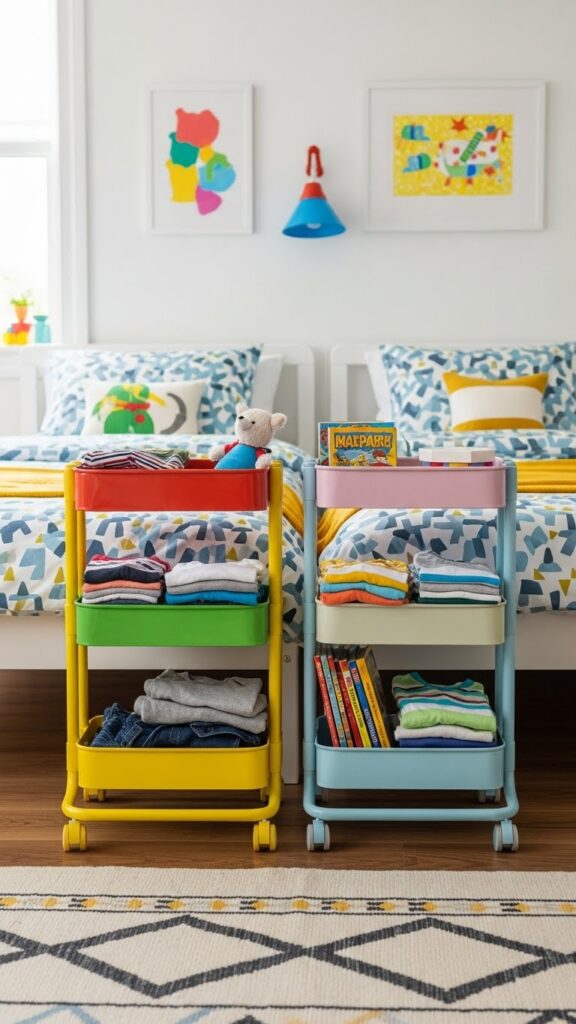
Rolling carts give each child portable storage they can move around independently. Assign each child their own three-tier rolling cart in their designated color. Kids can roll their cart to the closet during laundry day, to their bed when getting dressed, or wherever needed. This flexibility works brilliantly in cramped shared rooms where closet access is limited. Each child manages their own cart without interfering with their sibling’s space. The mobility also makes room rearranging easier as kids grow. For more small space solutions, check out our small kids closet organization ideas. Your storage rolls!
14. Create Morning Outfit Bins for Each Child
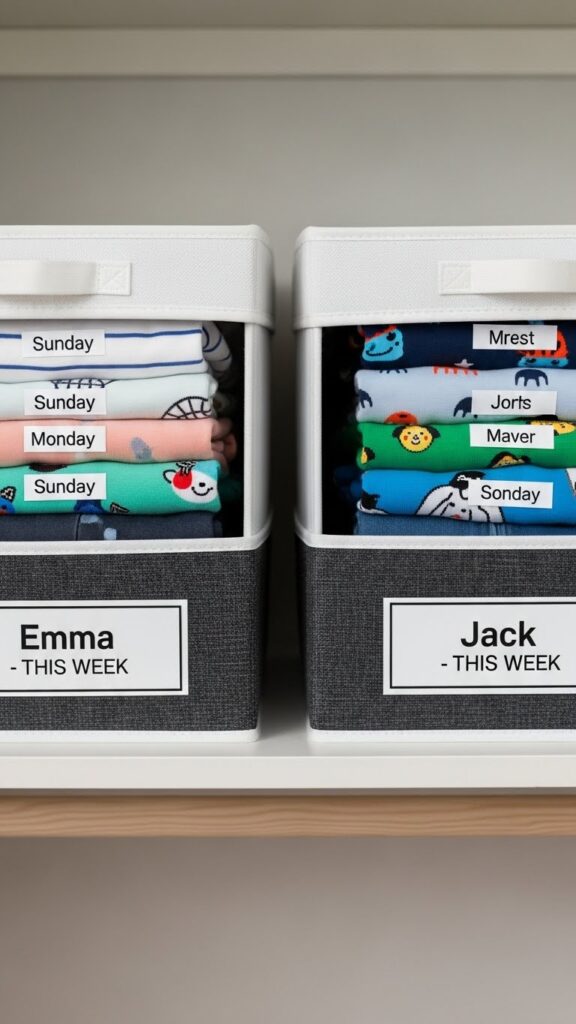
Individual morning outfit bins let each child grab their pre-planned clothes without touching their sibling’s stuff. Prepare a week’s worth of outfits on Sunday and place each child’s outfits in their designated bin. Label bins clearly with names and “Monday,” “Tuesday,” etc. This eliminates morning closet traffic jams when both kids need clothes simultaneously. Each child can get dressed independently without waiting for sibling closet access. The system reduces conflicts and speeds up morning routines dramatically. Your mornings separate!
15. Assign Specific Shelves by Height to Each Child
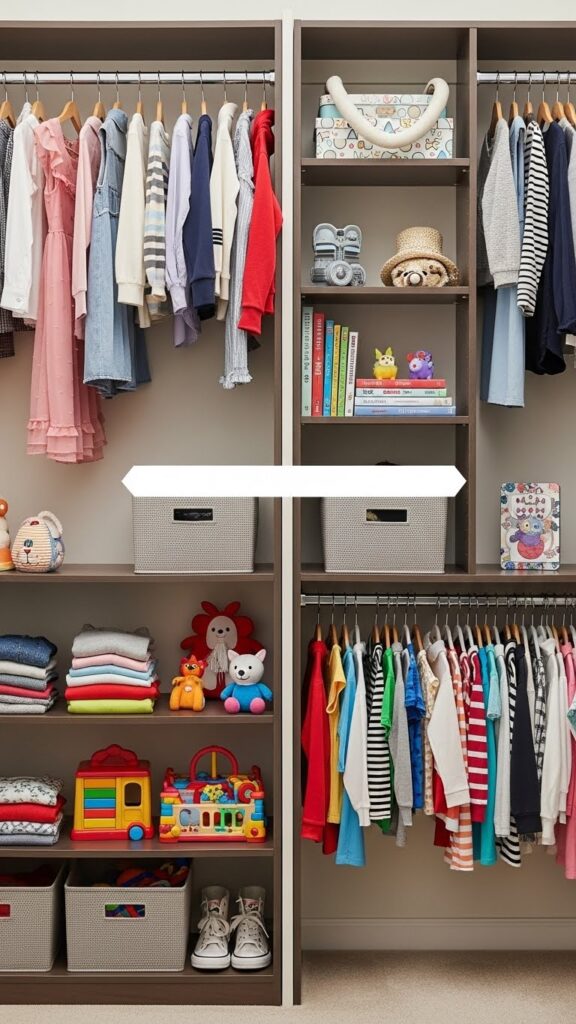
Height-based shelf division works naturally when siblings are different ages. Give the younger child the bottom shelves they can reach comfortably, and assign upper shelves to the older child. This age-appropriate organization promotes independence since each child can access their own items. The younger child won’t be tempted to climb to reach upper shelves, which improves safety. As kids grow, adjust shelf assignments to match changing heights and needs. This division feels fair because it’s based on practical ability. Your heights align!
16. Use Over-the-Door Organizers for Personal Items
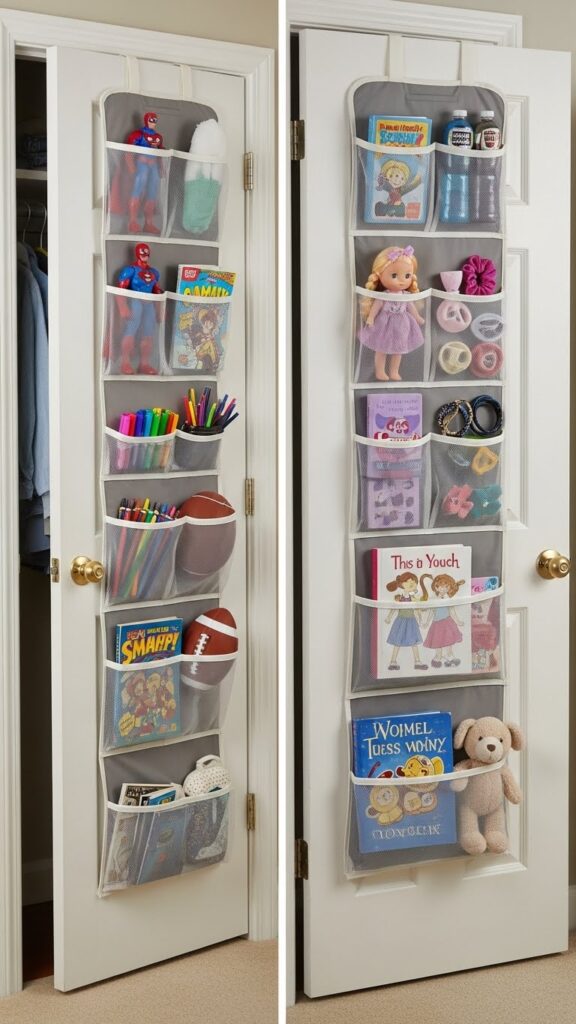
Separate over-the-door organizers give each child their own accessory storage that doesn’t compete for closet space. Hang one organizer on the closet door for one child, another organizer on the bedroom door or inside their designated closet side for the other. Each child fills their organizer with shoes, accessories, small toys, or whatever they need. The separation means no mixing of items and no arguments about pocket ownership. This approach works especially well for kids with vastly different storage needs. Your doors hold secrets!
17. Create Weekly Closet Maintenance as a Team Activity
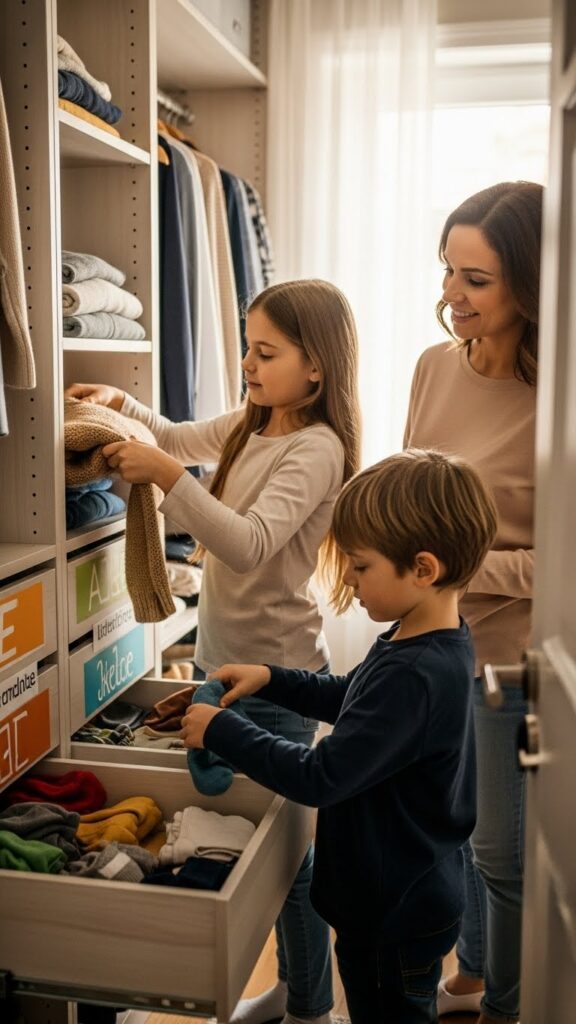
Weekly team maintenance teaches kids to respect shared spaces while managing their own zones. Set aside 15 minutes every Sunday for both kids to organize their designated areas simultaneously. They can help each other while learning to stay on their own side. This routine prevents small messes from becoming big battles and reinforces the boundaries system. Make it a positive activity with music or a reward when both sides look great. The consistency keeps the shared closet functional long-term. For families needing systems that adapt, our closet organization ideas for growing kids show age-appropriate strategies. Your team works together!
These 17 kids clothes storage ideas for shared bedrooms prove that siblings can share closet space peacefully with the right systems. By creating clear boundaries, using fair divisions, and maintaining consistent organization, you eliminate the daily battles over whose stuff is whose and who’s using too much space.
Start with one or two division strategies that address your biggest challenges maybe the color-coding system or the left-right split. Build from there as you discover what works best for your kids’ ages, personalities, and sharing dynamics.

Amir Ali is the founder and site administrator of HomeDecorEdge, a modern home decor and interior design platform. Since starting the site, he has combined his passion for interior design, practical styling, and color coordination with hands-on content strategy and site management. He guides authors, curates high-quality articles, and ensures readers have access to actionable, visually inspiring, and user-focused home decor advice for apartments, small rooms, and family homes.